

to feel is to love: ourselves, others, and god
To feel is human.
Yet so many of us spend our days trying not to.
To the degree that we are unable to express our emotions, we remain impaired in our ability to love ourselves, love others, and love God.
Somewhere along the way, we learned to hide or minimize our emotions. We were told to “be strong,” “get over it,” or “don’t cry.” Over time, those messages taught us that feeling deeply is weakness — when in truth, it’s what makes us fully alive.
When we deny our pain and losses year after year, we slowly become less human — empty shells with smiley faces painted on them.
We see this in our teens, too. They might shut down, say “I’m fine,” or avoid talking about what’s really going on. But often, they’re just doing what they’ve seen us do. If we want emotionally healthy teens, we have to start by modeling it ourselves.

when the newness wears off
The new school year buzz has faded. The excitement of new teachers, new routines, and fresh starts has been replaced with the reality of early alarms, packed schedules, and the endless cycle of homework, practices, and late-night snacks.
Everything that felt new and exciting a few weeks ago now feels... ordinary. The grind has officially set in.
And if we’re being honest, it’s not just the kids feeling it — we are too. That little twinge of mom guilt creeps in. Should I be doing more? Should I help them stay motivated? Or do they just need space to be tired and human for a bit?
I see it in my own teen — his determination to keep going, to give his best to everything he does. He doesn’t always know when to pause or that it’s okay to slow down. As parents it’s hard to watch our kids push themselves to exhaustion, but it’s also our reminder to help them find balance — to remind them that rest isn’t weakness. It’s wisdom.
Here’s what I’m learning — maybe the best thing we can do right now isn’t to fix anything, but to show up in small, intentional ways.

teens’ biggest complaint right now: exhaustion
f you ask most teens what they’re struggling with these days, you’ll hear it over and over: “I’m tired.”
And they’re not exaggerating. Our kids are over-scheduled, stretched thin, and trying to keep up with a pace that would exhaust even the most organized adult. Between high school sports, club sports, SAT prep, piles of homework, endless presentations, community service hours, and the pressure to still have a social life… It's no wonder exhaustion is their biggest complaint.
The truth is, sleep is not a luxury. Experts recommend teens get 8–10 hours of sleep a night—yet more than 70% of high schoolers don’t even come close. And it shows. Lack of sleep impacts mood, focus, learning, physical health, and emotional well-being. In fact, it’s strongly tied to higher levels of anxiety and depression in teens. When they’re running on too little sleep, their ability to manage emotions and stress plummets. No wonder they’re feeling so overwhelmed.
Somewhere along the way, sleep stopped being a priority in parenting. We shuffle them out the door at 5 a.m. for a game two hours away. We plan tournament weekends with five games crammed in. We sign them up for “just one more activity” because it feels like the right thing for their future. And even when they finally have a chance to sleep in, we poke our heads into their rooms with, “It’s 10 a.m., shouldn’t you be up and doing something?”
But what are we doing here?
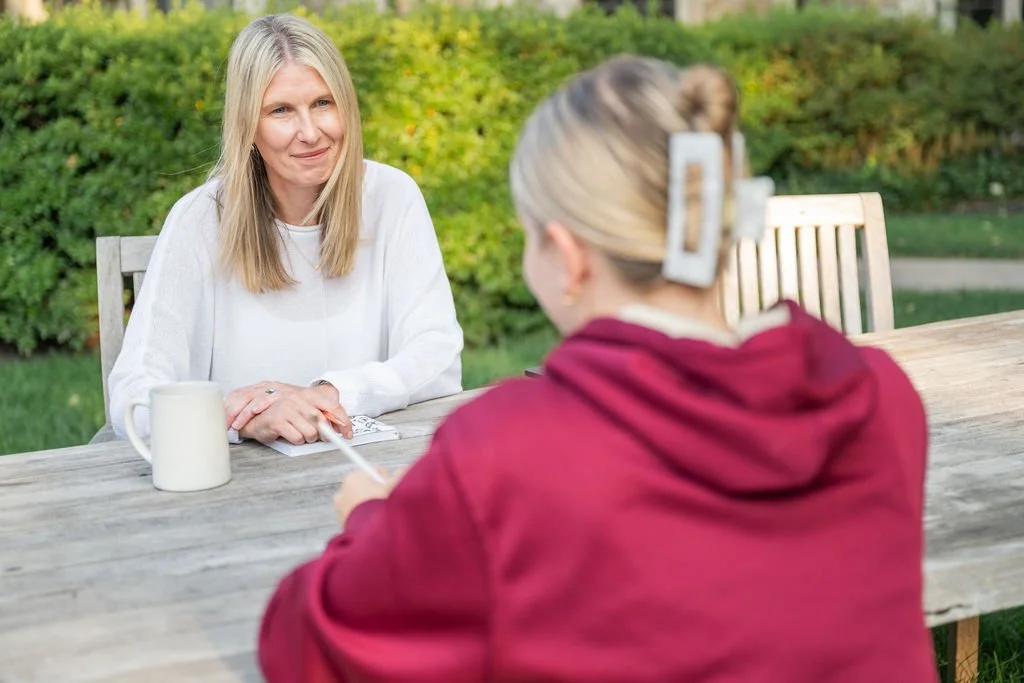
finding space to listen: how centering prayer is shaping my parenting
This month I started a new practice—centering prayer.
To be honest, I wasn’t sure how it would go. Sitting in silence doesn’t exactly come naturally to me. My mind likes to run, plan, solve, and prepare (especially when it comes to my teens and young adults). But what I’ve found is surprising: the more I give myself this space, the more I notice subtle changes in how I show up as a mom.
One of the biggest shifts has been in how I listen.
For example, as my sons begin to live their best college life, I’ve noticed myself stepping back. When they call (on those rare occasions—hehe), instead of jumping in with solutions or trying to fix, I’m simply listening. And something amazing has been happening. As I listen, they start to talk through their own next steps. They begin to land on their own solutions. It’s like they just needed me to hold space, not hand them an answer.

want your teen to stop comparing? start here.
That comparison game doesn’t just live in our adult world—it’s alive and well in our teens’ lives too. While you might be comparing homes, vacations, or finances, your teen is likely comparing grades, looks, friends, or sports. Different categories, same weight on the heart.
I know how heavy that can feel—for both us and them.
But here’s the truth ⤵
When we stop comparing our journey (and when we help our teens do the same), something shifts:
→ We begin to feel gratitude for our own path and what we already have.
→ We model what it looks like to give ourselves credit instead of judgment.
→ Our teens see us living it—and they learn to do the same.

hiring your inner coach: changing the game with self-talk
If we were to record the way we talk to ourselves all day long, most of us would be shocked. We would never say half of those things to a friend, a co-worker, or even a stranger in line at the grocery store—yet we speak them to ourselves without a second thought.
Why are we so mean to ourselves?
Maybe it’s because we’ve been conditioned to believe that being hard on ourselves will push us to do better. Or maybe those critical voices are echoes of what we’ve picked up along the way—from culture, family, or past experiences. Whatever the reason, negative self-talk is like having an inner bully running the show. And it’s exhausting.
But here’s the good news: you don’t have to let that voice have the final say.

breaking free from autopilot: helping ourselves (and our teens) actually live life
95% of our life is lived on autopilot.
We wake up, go through the motions, check off the boxes, and repeat.
And our teens? They’re right there with us. They know the expectations:
Get great grades.
Excel in sports or extracurriculars.
Get into a good college.
Land the right internships.
Graduate.
Find the “dream job.”
Get married.
Start a family.
It’s like the script has already been written, and all they have to do is follow it.
But here’s the question: What if we stopped for a moment?

when they don’t call home (and you’re losing your mind about it)
I just wrote a post about letting our teens experience life—the ups, the downs—without us fixing it for them. About giving them space to learn, grow, and move forward.
WELL. LET. ME. TELL. YOU. SOMETHING.
My middle one just left for his first few days of college and I am over here in full-on withdrawal mode. I’m doing everything in my power not to call him. I’m waiting for him to reach out. Meanwhile, I am hyper-focusing on “Where is he? What’s he doing? Is he eating? Is he safe?”
And then my brain goes spiraling:
“Oh my gosh, two of my kids are off to college. My youngest is basically raising herself at this point. I might as well be an empty nester already. This is it. They’re gone forever. College, then jobs, then marriage… This is the end of the road for me being the one they depend on.”
Dramatic? Maybe. Real? Definitely.
THIS. IS. HARD.

the other side of hard
The time has come. For some of our college kids, it’s move-in day. For others, it’s already begun — pre-season sports, Greek life rush, leadership training. Even for me, as a mom, it’s a season that brings a swirl of emotions.
On one hand, I’m excited and ready for my boys to step into this next chapter. I know the growth that’s ahead for them — and for me. On the other hand, I can’t ignore the deep pit in my stomach that whispers, this will change us.
Lately, with my teen clients, I’ve been talking a lot about the idea that life has to be hard sometimes — because that’s where the growth happens. For an athlete, pre-season is the perfect example. It’s grueling. The heat. The two-a-days. The physical exhaustion layered with the mental drain of new plays, new teammates, new coaches, and no real downtime to catch your breath.

bucket list magic: a day with abraham hicks
There are moments that sit on your heart for years, waiting for the right time to become real. And this week, one of those moments finally came to life.
My friend and I checked something off our bucket list that we’ve been talking about for over three years—we attended an Abraham Hicks workshop in Philadelphia!
If you’ve never heard of Abraham Hicks, she’s known as the queen of Law of Attraction. Her teachings are all about tuning into your thoughts, energy, and inner knowing to create a life that feels aligned and joyful. My first coach introduced me to her years ago, at a time when I desperately needed a mindset shift. Ever since, her voice and guidance have been a powerful presence in my life.
So to finally be in the room with her energy—live—was something special.
We had no idea what to expect, but we showed up open-hearted and ready for whatever the day had in store. From the moment we walked in, we felt it. The energy. The buzz. The lightness in the room. We kept catching ourselves smiling, like our faces forgot how to do anything else.